Process Safety and Scale-Up
Asia Mattelab is the distributor for H.E.L Group Battery Testing Calorimeter in Singapore and South East Asia (Malaysia, Thailand, Vietnam, Indonesia, Philippines).
H.E.L Group has a long history of solving complex challenges for customers. Since 1987, the Company has worked with businesses and laboratories globally, providing proprietary automated solutions for the pharma, biotechnology, chemical, battery, and petrochemical sectors.
In industries ranging from pharmaceuticals to fine chemicals, scaling-up bench-top chemical reactions to production volumes carries a number of risks and challenges.
Central to the risks involved with scale-up are the changes in heat loss behavior with scale:
- Many reactions are exothermic and require cooling to ensure safe operation when performed on a large scale;
- Components in the reaction may become unstable under certain operating conditions, leading to additional thermal hazards.
- Identifying and mitigating risk sources during the process scale-up is necessary.
H.E.L Group has a range of solutions to help you identify and quantify thermal hazards at the laboratory scale, which support your process safety and scale-up requirements.
TSu | Thermal and Pressure Hazard Screening Platform
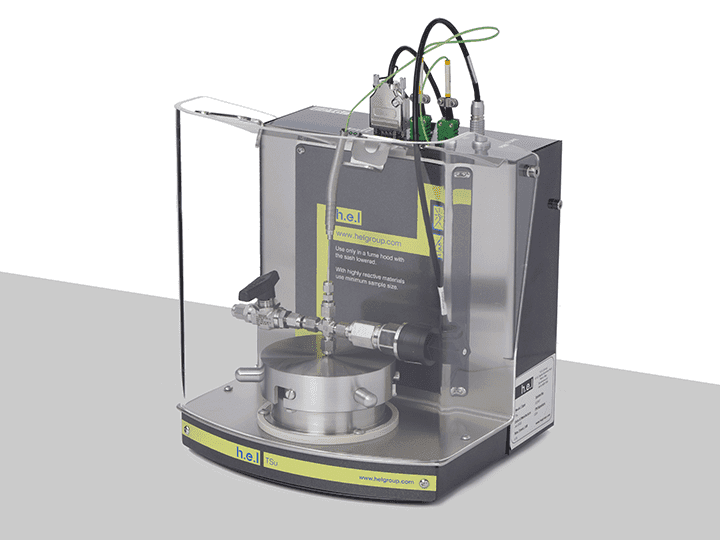
The fast screening of thermal hazards can be performed with the Thermal Screening Unit (TSu). It uses samples typical from 0.5 to 5g, will generate both temperature pressure data, and hence can be considered a better alternative to classical DSC/DTA methods.
The TSu typically finds application in:
- Thermal reaction screening of reaction hazards in process scale-up
- thermal stability studies on the reaction waste stream
This is due to its ability to characterize sample pressure changes in addition to thermal behavior, and its capability in supporting relatively large sample measurements.
For effective reaction hazard screening, two critical pieces of data are needed:
- the onset temperature (Td) of the reaction- where the exotherm is detected
- the pressure generated by the resultant runaway
Phi-TEC I | Bench-top, high phi-factor, adiabatic calorimeter
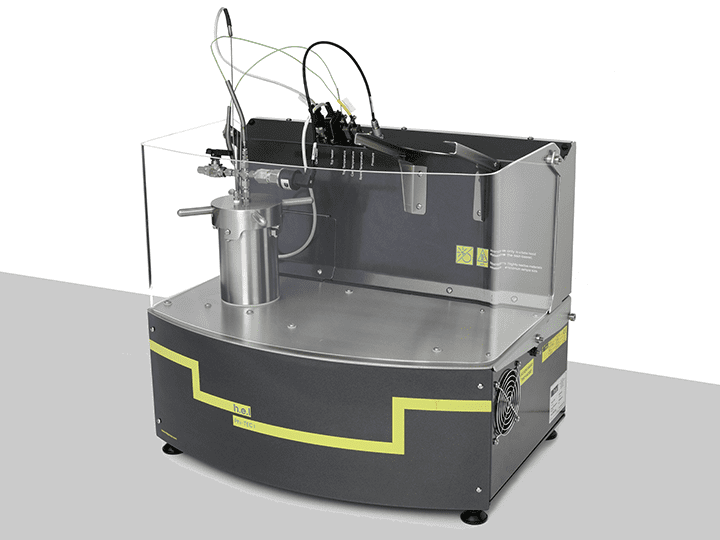
Via direct sample temperature measurement and by rapidly responding to any thermal changes, the Phi-TEC I accurately tracks exothermic events and maintains adiabatic conditions. This adiabatic screening enables thermal events to be defined with the accurate characterization of the onset temperature (Td) and facilitates the calculation of other key parameters, such as the rate of pressure change, the adiabatic temperature rise (∆Tad,d), and the time to maximum rate (TMRd).
Adiabatic calorimetry
Large scale reactors lose very little of the heat generated in a reaction to the surroundings. This poses a potential hazard when operating at large scale, as that heat will be retained within the reactor. At best this will require plant cooling and at worst may trigger a thermal runaway.
The Phi-TEC I mimics the processes at large scale, while operating at laboratory volumes.
Phi-TEC II | Bench-top, low phi-factor, adiabatic calorimeter
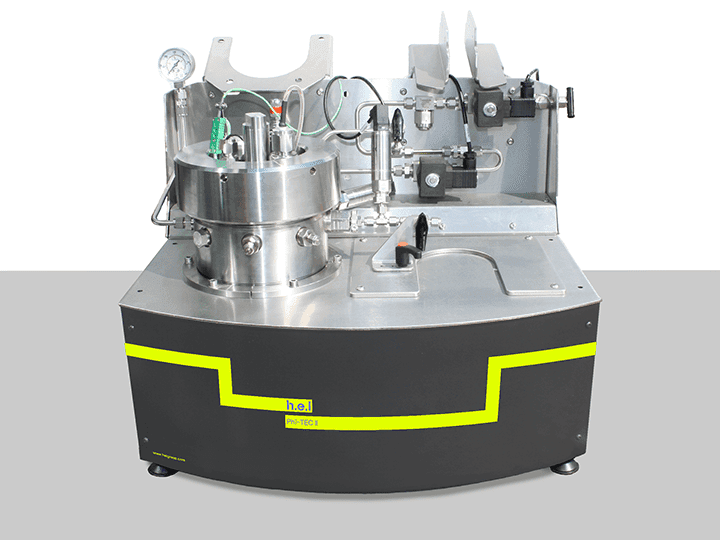
The Phi-TEC II is an adiabatic calorimeter, which supports the use of low Phi-factor test cells. This allows for manufacturing plant conditions to be fully replicated on a lab-scale thus allowing thermal runaway risks to be simulated and assessed. Utilizing low-Phi factor cells means that the runaway rate is not tempered by the test equipment, and subsequently, the measured rate of pressure increase and final temperature (Tend) – along with the calculated Time to Maximum Rate (TMRd) and adiabatic temperature rise (∆Tad,d) – are representative of what would be expected to occur during a production-scale incident.
The impact of different operating scenarios can be explored using the Phi-TEC II, and the data generated can be utilized to determine appropriate safety controls for the manufacturing plant, such as:
- Emergency and evaporation cooling
- Quenching
- Controlled depressurization
- Vent sizing (in accordance with DIERS methodology)
Thus, the Phi-TEC II enables hazards to be fully evaluated, enabling their mitigation prior to scale-up.
Simular | Process Development Reaction Calorimeter
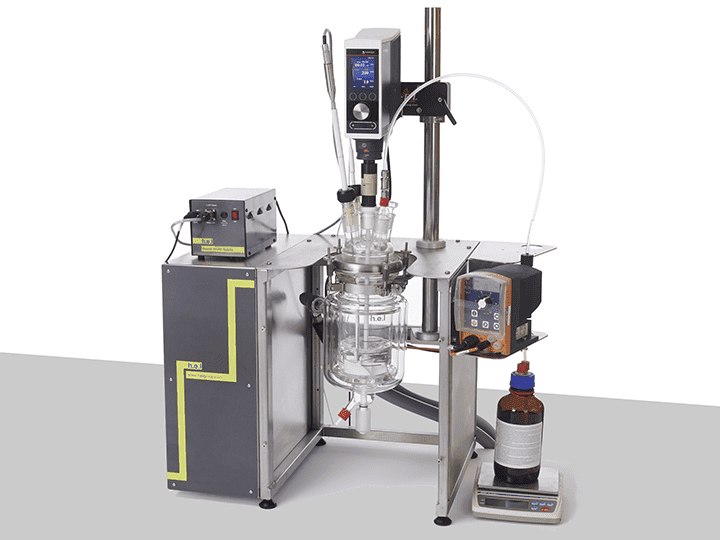
The Simular is a reaction calorimeter that is used within process development to investigate the thermal properties of a chemical reaction under the proposed operating conditions. The Simular allows for the optimization of process conditions for maximum product yield and minimal safety hazards, based on the derived thermodynamic and kinetic information of the reaction.
The Simular enables the determination of the plant cooling capacity required to keep a reaction isothermal (Tp), and the calculation of the maximum temperature the main reaction will reach in the event of a thermal runaway. The parameter known as the Maximum Temperature of Synthesis Reaction (MTSR) is a critical value in determining whether the emergency cooling capacity in a plant is capable of dealing with an increase in temperature. The Simular can be used to determine safer reaction conditions.
The Simular supports both the classical heat flow calorimetry method, and the quicker, more efficient, calibration-free power compensation calorimetry method, allowing selection of the most appropriate method for the scenario that is of interest.